


Make: TAYLOR
Model: TXH350L
Year: 2016


Make: Manitou
Model: 48" Forks
Year: 2012

Make: JLG
Model: Truss Jib 12'
Year: 2011

Make: Capacity
Model: TJ5000 DOT
Year: 2010

Make: JLG
Model: 450AJ
Year: 2016

Make: FrostFighter
Model: IDF350
Year: 2015
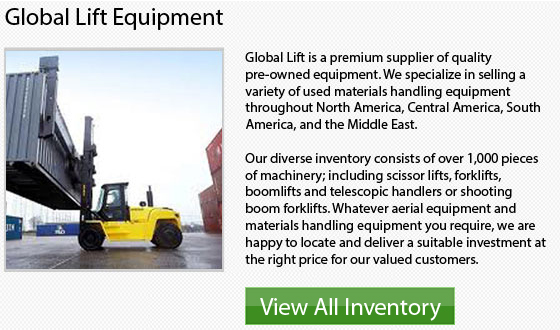
Nissan Counterbalance Forklifts San Jose
The counterbalanced forklift is a lift truck which utilizes a counter balance which is attached to the back end of the equipment. This counterbalance effectively balances loads that are positioned on the blades at the front end of the equipment. This particular design is engineered to stabilize conventional lift trucks. As far as electric counterbalance forklifts are concerned, the battery itself forms the counterweight.
Counterbalance forklifts could often be found in every manufacturer's product range. They are typically manufactured in a variety of sizes and configurations, using a variety of fuel sources. These lift trucks can with pneumatic or solid tires, and be designed with 3 or 4 wheels. They are capable of working in various applications. These types of lift trucks are outfitted with different kinds of accessories. Common attachments and options consist of: slip sheet attachments, fork shifts, side shifts and hydraulic clamps just to mention a few.
Counterbalance lift trucks have revolutionized the material handling industry. They have become the cornerstone of storage and distribution systems where they perform stacking, loading, horizontal transport functions and unloading. The average warehouse forklifts are usually utilized for lift heights less than 6 meters or 20 feet. There have been some models recently developed that are capable of lifting to heights 31 feet or 9.5 meters. The smaller 1-1.8 ton or 4000 pound forklifts are the main workhorses in most warehouses. These are the most popular models which most small businesses will have. The average warehouse counterbalance forklift is really a wide-aisle truck that needs roughly 3 meters or 11 feet to turn in.
Counterbalance forklifts are not necessarily limited to the warehouse. They are often used for container carrying and heavy use along with basically every use in between. Counterbalance forklifts are the most versatile and widely utilized of all materials handling machinery.
Because of their durability and versatility, counterbalance forklifts are commonplace in a huge range of working environments, including retail, warehousing and production. Some of the industrial applications consist of: food, chemical, automotive and timber industries.
- Hyundai Narrow Aisle Forklifts San Jose
Narrow Aisle Forklifts Narrow aisle forklifts are particularly designed so as to fit down very narrow warehouse aisles. This provides some advantages to business owners such as greatly increasing their space to store things. Even... More - Caterpillar Reach Stackers San Jose
A reach stacker is a vehicle designed to handle the movement of containerized cargo within small and medium-sized terminals and ports. Reach stackers are really perfect for quickly shuttling containers short distances and piling them... More - Manitou 4 Wheel Drive Forklift San Jose
Vertical Masted Forklift The vertical masted or straight masted lift truck is a great equipment for your material handling needs. These types of machines are an ideal choice for times where both maneuverability and stability... More - Clark LP Forklifts San Jose
How to Fill Forklift Cylinders Liquid propane is usually used to operate industrial lift trucks or forklifts. There is the choice to have refueling capabilities on site or to have cylinders delivered to your facility.... More - JLG Rough Terrain Scissor Lift San Jose
Model 150HAX JLG's 150HAX model Rough Terrain Scissor Lift is the leader of its class within the market of self-propelled articulating boom lifts. This model has the longest outreach at 79 feet, 3 inches or... More